Spend enough time in this field and you start to collect the one-liners. Mention you're a physiotherapist and you'll hear:
"Oh, you're a physio? Can you quickly crack my back?"
"A physio, hey, massage my neck for me?"
Say you're a biokineticist, and it's usually:
"Oh, you're a bio? Can you stretch out my hamstring?"
"A bio, so you basically write gym programmes, right?"
Everyone has a mental shortcut for what each of us does, and those shortcuts are half right at best. A physio is far more than a pair of hands for a sore neck, and a biokineticist is a lot more than a stretch-and-gym coach.
Here's the simplest way to think about it. Physiotherapists take you through the early, acute stage of an injury using hands-on treatment. Biokineticists take over in the final, exercise-based stage, then stay with you through long-term conditioning, chronic-disease management and injury prevention. They aren't competitors. They're consecutive stops on the same road to recovery.
What they share
Both professions are registered with the Health Professions Council of South Africa (HPCSA), under the same board (Ellapen et al., 2018). Both are first-contact practitioners, so you don't strictly need a doctor's referral to see either. And the HPCSA scope of both allows them to prescribe rehabilitative exercise, which is exactly why they get confused. The real difference is when in your recovery each one leads, and what tools they're allowed to use.
Who handles which phase of rehab
Picture recovery as a continuum, from injury to full return to sport or daily life.
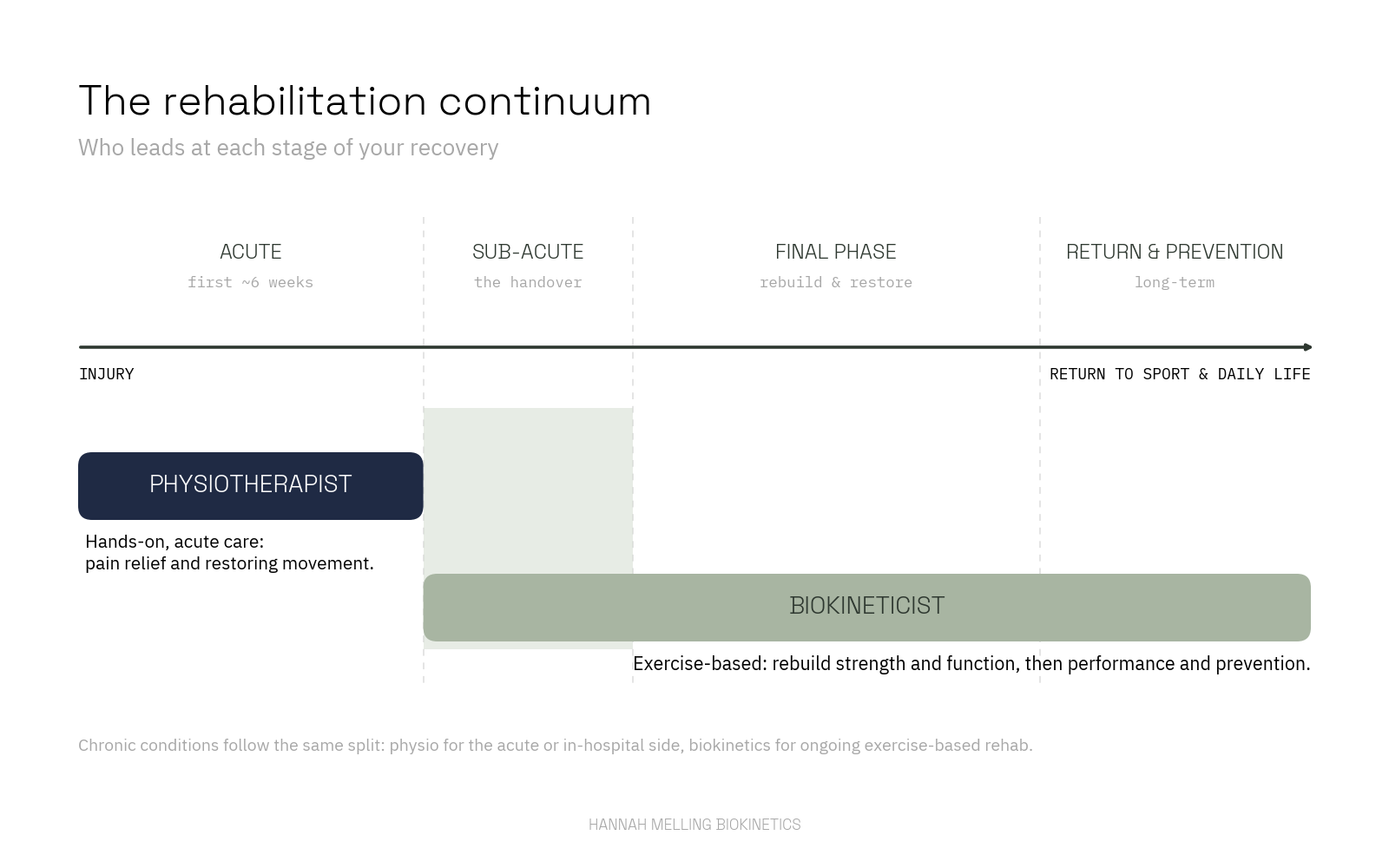
The acute phase (roughly the first six weeks) belongs to the physiotherapist. Early on, the job is controlling pain, protecting healing tissue and restoring basic movement, which relies on hands-on, passive treatment. For a sudden injury, like a torn muscle, an acute sprain, or a post-surgical joint, the physio is your first stop.
The middle phase is the handover zone, where the two overlap. As pain settles and tissue tolerates more load, treatment shifts from passive techniques to active, graded exercise, and you're often referred across to a biokineticist.
The final phase belongs to the biokineticist. The HPCSA describes biokinetics as a final-phase functional profession that improves your health through prescribed exercise (Ellapen et al., 2018). This is where you rebuild strength and endurance, restore full range of motion, retrain proprioception (your sense of joint position and control), and get back the movement patterns you need for sport and daily life. For overuse injuries especially, the bio is often the better fit, because the fix is mostly about exercise and load.
Injured or just out of surgery? Start with a physio. Past the acute stage and rebuilding? That's a biokineticist's job.
Beyond rehab, the biokineticist keeps going, into conditioning, performance and preventing the injury from coming back. That's a clear point of difference from physiotherapy.
With chronic conditions the split is similar. The physio handles the acute or in-hospital side, and the bio handles the ongoing, exercise-based side, like cardiac rehabilitation and managing diabetes or other chronic diseases through structured activity.
What each one actually does
This is where the "physios can do things bios can't" idea comes from.
A physiotherapist's toolkit is broad and hands-on: manual therapy (joint mobilisation and manipulation), soft-tissue work including massage, electrotherapy, dry needling and exercise therapy, plus acute injury management and areas like neurological and cardiopulmonary rehab.
A biokineticist's toolkit is exercise. Biokinetics is defined as an exercise-therapy profession that prescribes individualised exercise for rehabilitation and health. A bio assesses your movement, strength and function, then prescribes and coaches a tailored programme.
The key boundary is this. A biokineticist does not do passive hands-on treatment. Massage, manipulation, electrotherapy and dry needling all sit in the physiotherapist's scope and fall outside the biokineticist's (Point Physiotherapy, 2025). So if you want your neck massaged, that's a physio service.
Plenty of goals overlap, but the toolkit is different. A physio's strength is hands-on, passive treatment. A bio's strength is precise, progressive exercise.
Plenty of goals overlap, though. Both professions work on things like range of motion and proprioception, physios often earlier and more hands-on, biokineticists through loaded exercise in the later phases. What separates the two is the toolkit, not the goal. A bio's strength is the opposite of the physio's hands-on approach: the precise, progressive use of exercise as medicine.
What each one studies
Physiotherapy is a four-year degree (BSc Physiotherapy or BPhysio) plus a compulsory community-service year before HPCSA registration. It covers the basic medical sciences alongside manual therapy, electrotherapy, hydrotherapy and exercise therapy, with heavy clinical placement.
Biokinetics has traditionally run as a "3 + 1": a three-year Sport Science or Human Movement Science degree, an honours year specialising in biokinetics, a clinical internship and a national HPCSA board exam. Several universities now offer a four-year professional degree. The curriculum centres on exercise science: anatomy, exercise physiology, biomechanics, and above all exercise assessment and prescription.
What each can add afterwards
Both need ongoing professional development to stay registered, but they grow in different directions.
Physiotherapists add postgraduate courses like dry needling, manual therapy, sports physiotherapy and clinical Pilates, deepening skills already inside their scope.
Biokineticists grow within the exercise scope, with things like strength-and-conditioning credentials (for example the NSCA's CSCS) or further specialisation in cardiac rehab or specific athletic groups. What they can't do is bolt on massage, needling or electrotherapy, because those stay outside the profession's scope. A bio gets more specialised by becoming a better exercise clinician.
They work best together
This was never a turf war. The two professions were built to complement each other, and the research treats them as collaborators (Nkabinde et al., 2024). For something like osteoarthritis, the ideal is a team: flare-ups eased with the physio's hands-on techniques, and long-term function built through the bio's exercise programming.
So who should you see?
- Just injured, in pain, or fresh out of surgery? Start with a physiotherapist.
- Past the acute stage, nursing an overuse niggle, or ready to rebuild and return to sport? See a biokineticist.
- Managing a chronic condition, or wanting to train smart and prevent injury? A biokineticist is your long-term partner.
Often the best outcome comes from seeing both, in the right order.